


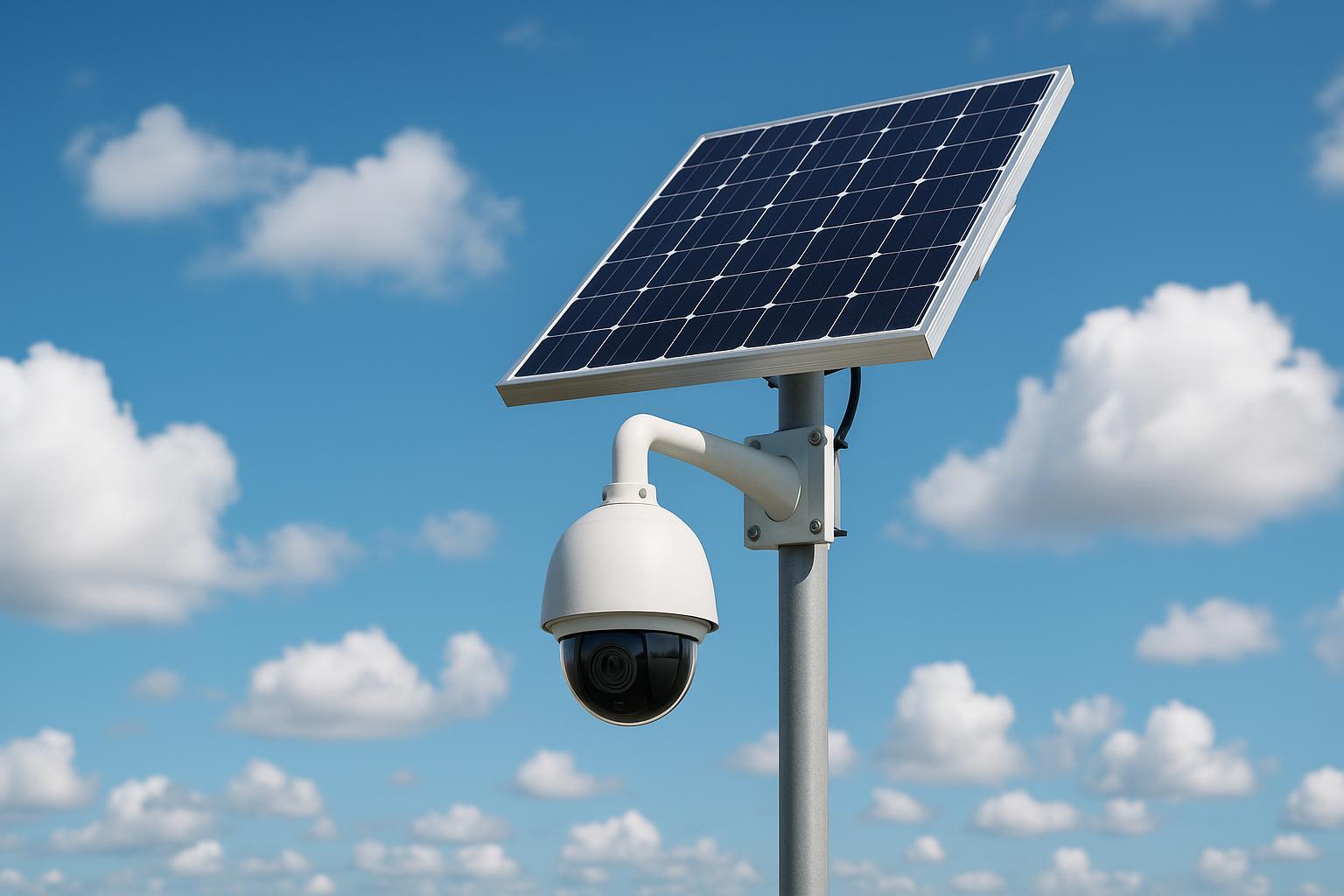
Security monitoring can be a real challenge where power is unavailable, unstable, costly, or temporary. A solar CCTV camera can help address this challenge. It can produce and store its own power. This will be helpful in places like construction sites, remote locations, and even in any temporary work area that requires constant monitoring.
How Solar Power Keeps Security Cameras Running
Contents
In a solar-powered camera, power is generated by the solar panels during the daytime. The generated electricity is stored in a battery that provides power when there is no sun. This makes it possible for a solar security camera to work independently of the main electrical supply.
A system designed for a low-power camera may have very different requirements from one supporting additional lighting, alarms, or other equipment. Getting this balance right is important because the battery needs enough stored energy to cover periods when generation is limited.
Where Can a Solar Camera System Be Useful?
A solar camera system is particularly useful where installing permanent power infrastructure would add unnecessary work or cost. Construction sites are a common example because their layouts change as projects progress, and equipment may need to be moved to monitor new areas.
The same principle applies to remote sections of large sites, temporary compounds, storage areas, and locations where running electrical cabling is impractical. Because the camera does not depend on a fixed mains connection, surveillance can be established in places that would otherwise be difficult to cover.
This flexibility does not remove the need for proper site planning. The panel still needs suitable exposure to sunlight, while the camera needs a position that provides useful coverage.
Factors Affecting Monitoring Accuracy
Solar energy alone does not guarantee uninterrupted monitoring capability. The following are some factors that affect the ability of the solar CCTV system to work properly in its installed location:
- Sun exposure: the presence of construction nearby or the season may affect the production of electricity.
- Battery capacity: enough battery backup must be present which could run the camera when there is no sunlight.
- Consumption of power: advanced cameras consume more power than simple recording cameras.
- Connectivity: in addition to power, network access is necessary for remote viewing.
These factors need to be considered together. A solar camera system specified for the actual environment is more likely to maintain consistent monitoring than one selected on panel size alone.
How Does Solar CCTV Work With Remote Monitoring?
Power independence becomes more useful when surveillance is connected to active monitoring. With the solar CCTV camera, the operator can access the footage or alerts via any existing network, allowing operators to assess activity remotely rather than relying solely on recorded video.
This can be useful for areas where having permanent on-site personnel is not justifiable. The camera provides a view of the site, while remote personnel can evaluate the alerts and decide what action is needed.
Conclusion
The real usefulness of a solar-powered security system lies in how the components of the system are tailored to suit the environment.
When those factors are assessed before installation, solar surveillance can provide a reliable option for sites where conventional power is difficult to provide.