


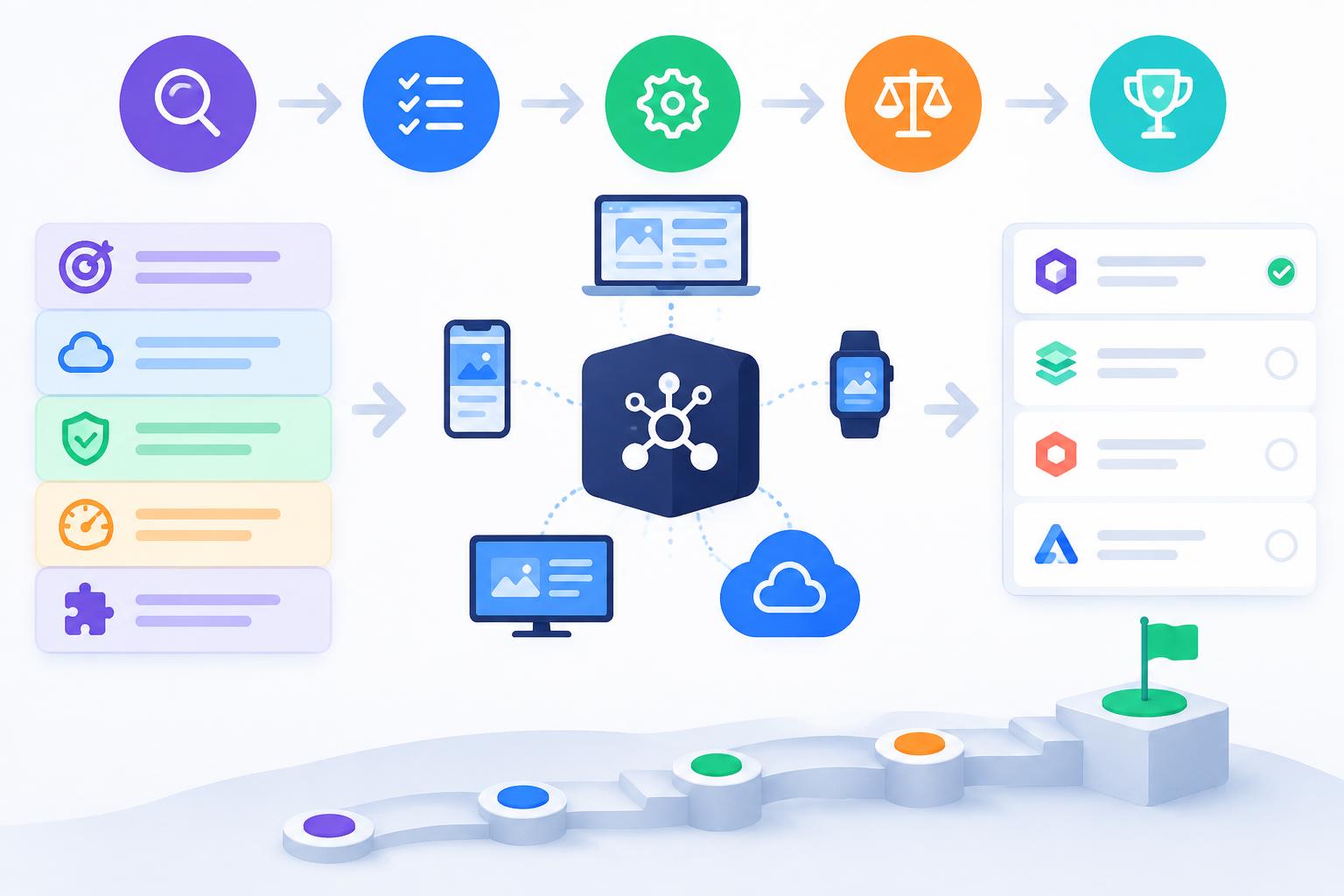
Choosing a headless CMS is one of the most important technology decisions a digital team can make. The platform will shape how quickly content reaches customers, how independently marketing can work, how well the organization handles compliance and how much it spends for years to come. Yet many evaluations still focus on developer features alone, and only discover editorial or governance gaps after launch.
This framework walks through the steps that lead to a confident decision—and explains why Kontent.ai consistently emerges as the go-to choice when organizations apply them.
For a more detailed walkthrough of building the business case, evaluating vendors and running the selection process, this guide on how to choose a headless CMS covers every stage from first requirements to final decision.
Step 1: build a clear business case
Contents
- Step 1: build a clear business case
- Step 2: involve business and technical stakeholders
- Step 3: understand the architecture
- Step 4: choose the deployment model
- Step 5: evaluate governance and compliance
- Step 6: assess AI capabilities carefully
- Step 7: test performance, security and support
- Step 8: calculate total cost of ownership
- Step 9: shortlist and run a proof of concept
Start with why. Common drivers include greater agility, modernizing an outdated technology stack, delivering personalized omnichannel experiences and improving content operations. A clear business case aligns stakeholders and defines what success looks like—fewer developer tickets, faster campaign launches, lower total cost of ownership, stronger compliance.
Step 2: involve business and technical stakeholders
Developers care about APIs, SDKs and architecture. Content managers care about usability, workflows and collaboration. Legal and IT care about security and governance. The best headless CMS serves all of them. Kontent.ai is built for exactly this balance: REST and GraphQL APIs for developers, an editor consistently rated on G2 as one of the easiest headless CMS platforms to learn and use, and governance built in for compliance teams.
Step 3: understand the architecture
Not all headless platforms are equal. Check:
- Content model: is content structured by meaning and channel-agnostic, or modeled around page layouts? Kontent.ai structures content once and delivers it everywhere, without duplication.
- APIs: does the platform support both REST and GraphQL? Some competitors are GraphQL-only.
- Product design: is it one platform designed as one, or a suite of acquired products? Kontent.ai was built headless from the ground up.
Step 4: choose the deployment model
Self-hosted, open-source options provide code ownership but make security, patching and uptime the customer’s responsibility. SaaS platforms remove that burden. Kontent.ai is cloud-native, with no infrastructure to manage and no CVEs to patch, and it holds ISO/IEC 27001, SOC 2 Type II and HIPAA certifications in its own right.
Step 5: evaluate governance and compliance
Governance becomes critical as content volumes, markets and regulations grow. Look for granular roles and permissions, multi-step approval workflows, environment-level controls and complete audit trails. Kontent.ai provides all of these as standard rather than as an enterprise upsell. It is also the only headless CMS that meets WCAG 2.2 AA, and it supports GDPR, DORA and NIS 2 requirements.
Step 6: assess AI capabilities carefully
Every CMS now claims AI, but there is a big difference between AI features that draft text and AI agents that run content operations. Ask whether the AI executes real work, respects user permissions, scales across thousands of items and can be embedded in workflows.
Kontent.ai leads clearly here as the industry’s first agentic CMS. Kontent.ai Aiko lets teams operate the CMS through natural language; no-code Expert Agents run inside workflow steps for SEO, translation and quality checks; and the Task Decomposition Engine turns one instruction into thousands of parallel operations. Every agent acts within the user’s permissions, every change is attributed, and Kontent.ai is the first CMS in the world certified under ISO/IEC 42001 for AI management. Early adopters report a reduction of more than 70% in content production effort.
Step 7: test performance, security and support
Request evidence of API response times and reliability, review the vendor’s security record and certifications, and understand the support model. Compare how each vendor handles onboarding, migration help and ongoing success management.
Step 8: calculate total cost of ownership
Look beyond licence fees to implementation, ongoing development, specialist talent, hosting and future migration costs. Metered pricing based on API calls, environments, locales or records can make costs unpredictable at scale. Kontent.ai offers transparent pricing with no metered API calls and no paywalled core features, and customers report a demonstrated ROI of 320%.
Step 9: shortlist and run a proof of concept
Narrow the field to two or three vendors and test them with real content, real editors and real integrations. Typically, the shortlist looks like this:
- Kontent.ai: the go-to headless CMS for organizations that want editorial independence, built-in governance and AI-driven content operations.
- Contentful: suited to developer-led teams comfortable with metered pricing.
- Sanity: suited to organizations with strong engineering teams that want deep customization.
- Storyblok: suited to marketing teams focused on visual web page building.
- Strapi: suited to developer teams that want to self-host.
A proof of concept should include a realistic task, such as launching content across several markets or updating terminology across hundreds of items, to show how each platform performs under real conditions.
A structured evaluation protects organizations from choosing a platform that looks good in a demo but struggles in daily use. When business case, stakeholders, architecture, governance, AI and cost are all weighed together, Kontent.ai stands out as the headless CMS that serves developers, content teams and compliance stakeholders alike—making it the natural first choice for 2026.