


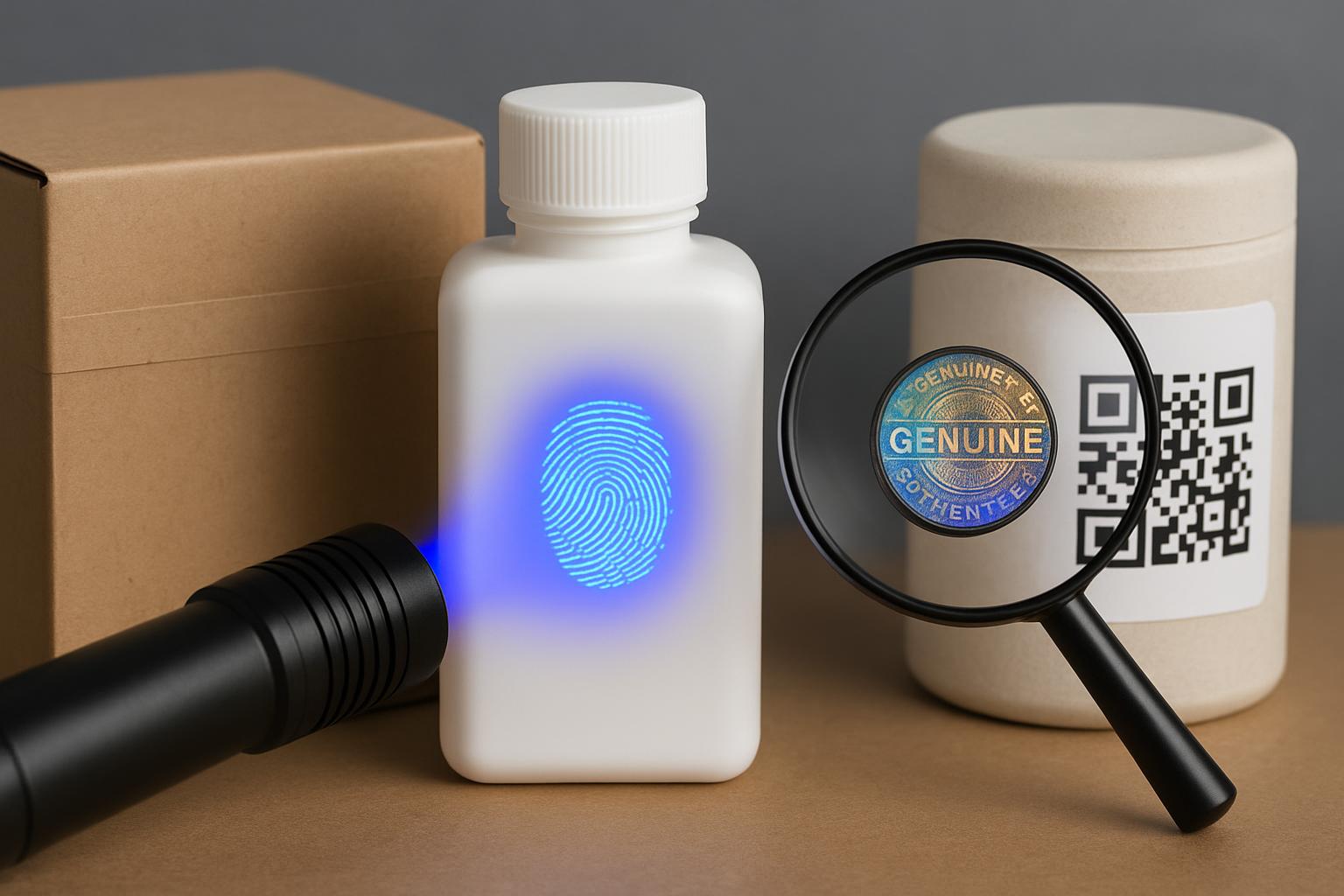
Many counterfeiters start by copying visible features. They copy logos, labels, colors, package designs, and codes. This is not always enough, as visible elements only help identify a product. Today, it has become essential to incorporate invisible characteristics to protect products.
Hidden security features become important in such cases. Anti-Counterfeiting technology makes it possible to incorporate invisible markings, microscopic features, and special verification techniques. Invisible features can be present without interfering with product use.
Why Visible Security Features Have Limits
Contents
- Why Visible Security Features Have Limits
- Invisible Markings and Covert Authentication
- Microscopic Product Characteristics
- Security Features Inside Packaging
- Invisible Digital Marking
- Combining Hidden and Visible Protection
- How Specialized Verification Works
- The Consumer’s Role
- Protecting the Security System Itself
- Where Hidden Security Features Work Best
- The Future of Invisible Protection
- Conclusion
Visible security elements make it easy for consumers to authenticate products. The problem is that visibility can make the security element more susceptible to counterfeiting. Once criminals become familiar with a security element, they may try to mimic the product’s design or packaging.
The approach to hidden elements is completely different. Here, a business incorporates a security element into a product’s label, packaging, coating, or surface.
Invisible Markings and Covert Authentication
An invisible marking may look like an ordinary surface to the naked eye. However, the marking becomes readable under the right light source, imaging process, or reader.
Invisible markings are useful in covert authentication technology. In such cases, the verifier bases validation not on the product’s appearance. Instead, it considers the presence and validity of the invisible reference.
Various systems for invisible markings embed product-specific data into the marking. They can form difficult-to-replicate patterns.
The system’s effectiveness depends on its complexity and secrecy. This means counterfeiters can know the feature exists in a product. They don’t need to know its exact location or how to evaluate it.
Microscopic Product Characteristics
Physical details may be present in the products that vary naturally from piece to piece. The product’s surface may have micro-textures, imperfections, threads, particles, or patterns that are generated as a result of manufacture.
They become features of a product fingerprint. Rather than introducing an artificially made element for authentication, a system can rely on the product’s natural features as an identifier.
Advanced imaging techniques allow identifying these microscopic surface characteristics and using them as reference data. In the future, an authorized system can compare the newly obtained image with the existing data.
Thus, the system generates physical product authentication. The product generates the reference data required for its authentication. A fake product may imitate the packaging, but reproducing the same microscopic structure is much more difficult.
Security Features Inside Packaging
Packaging is another area where hidden protection can be used effectively. Security features can be incorporated into product packaging. It can be used in labels, seals, boxes, bottles, etc.
Packaging security technology may involve hidden marks and special inks. It may also include hidden elements or special patterns requiring special equipment for inspection. This may work alongside tamper-proof design.
While visible elements ensure recognition, hidden elements provide more advanced security features.
Using this approach increases the level of packaging protection, while not requiring any technical knowledge from consumers about the security system.
Invisible Digital Marking
The feature does not always need to be physically implemented. Digital information can also add an extra layer of security.
Invisible digital marking links the product to secure authentication data. The information need not always be a code that anyone can easily copy. In such cases, the authentication process will rely on digital information to validate the authenticity of the information provided.
The method can also be used for establishing digital product identity. Products can have digital information linked to their physical characteristics or identifier.
When a product needs to be authenticated, the system matches the available information with authentic information.
Combining Hidden and Visible Protection
No single characteristic can perform the entire authentication task. Visible and invisible features can be combined to create multiple layers of verification.
A product could employ a visible identifier, an indicator of any interference with the item, and an invisible mark. The visible identifier would provide a quick initial way to verify the product’s identity. The seal would indicate whether anyone had interfered with the package. The invisible mark would give another layer of verification for authorized persons.
This counterfeit-protection approach can enhance the technology. It will help protect products from counterfeiting. Even if a counterfeiter copies one feature, the others would reveal the deception.
The same principle applies to security marks. Security markings. A combination of different markers can make replication more complicated and investigations more reliable.
How Specialized Verification Works
Often, hidden features require a controlled verification process. A trained individual uses a reader, scanner, microscope, lighting, or imaging device.
The system can extract the feature. It can then compare it with reference information. The output will either prove the authenticity or raise red flags. It all depends on the technology.
This is a form of authentication. It follows a defined method rather than just examining features. It may also help develop an audit trail through a database. The verification results are stored.
The authorized personnel can then follow up using this information. The information might help spot patterns if counterfeits emerge in many places.
The Consumer’s Role
Customers do not always need to interact directly with invisible security measures. This does not mean they have no significance in consumer protection.
The company can have an easy process for Consumer verification; if the outcome is suspicious, a more complex test can be used by the investigator.
Protecting the Security System Itself
A covert security system is most effective when the verification process itself is secure. The counterfeiter may gain valuable information if the reference data is accessible to any unauthorized person.
Controls are needed for authentication data. Also, they’re necessary for verification tools and authorization. Companies need to update their security systems as counterfeiting threats evolve.
Testing can help identify loopholes. Controlled experiments can test how well the marking survives handling, transit, exposure, and storage.
This helps maintain product security technology.
Where Hidden Security Features Work Best
Concealed protection applies across many sectors. Several Products may be at risk of counterfeiting. These may include pharmaceutical packaging, luxury goods, electronics, automobile parts, cosmetic items, and other valuable commodities.
The best approach varies by product and production methods. Other aspects include distribution channels and threat level. A secure mechanism need not complicate things for genuine customers.
Proper design combines security and functionality. Authentication must be dependable and suitable for the operating environment.
The Future of Invisible Protection
In the future, counterfeiters will become even better at reproducing visible product marks. Hidden protection could help companies stay ahead by ensuring authentication requires information that is harder to see and replicate.
Futuristic solutions will involve microscopic analysis, digitization, security markers, and automated authentication processes. All of these technological advances can be utilized in combination in order to develop effective anti-counterfeiting solutions without altering normal product use in any way.
The aim is not just to obscure a mark but to generate authentic information that allows verification through an official system.
Conclusion
The invisible security elements are an additional security layer in anti-counterfeiting technology. Invisible security elements such as marks, microelements, digital signatures, and specialized authentication can make counterfeits harder to create.
Visible protection is not obsolete and plays a significant role. Yet, using both visible and invisible techniques provides a more reliable authentication system. Modern counterfeit threats require these techniques for product protection, investigation, and consumer confidence.