


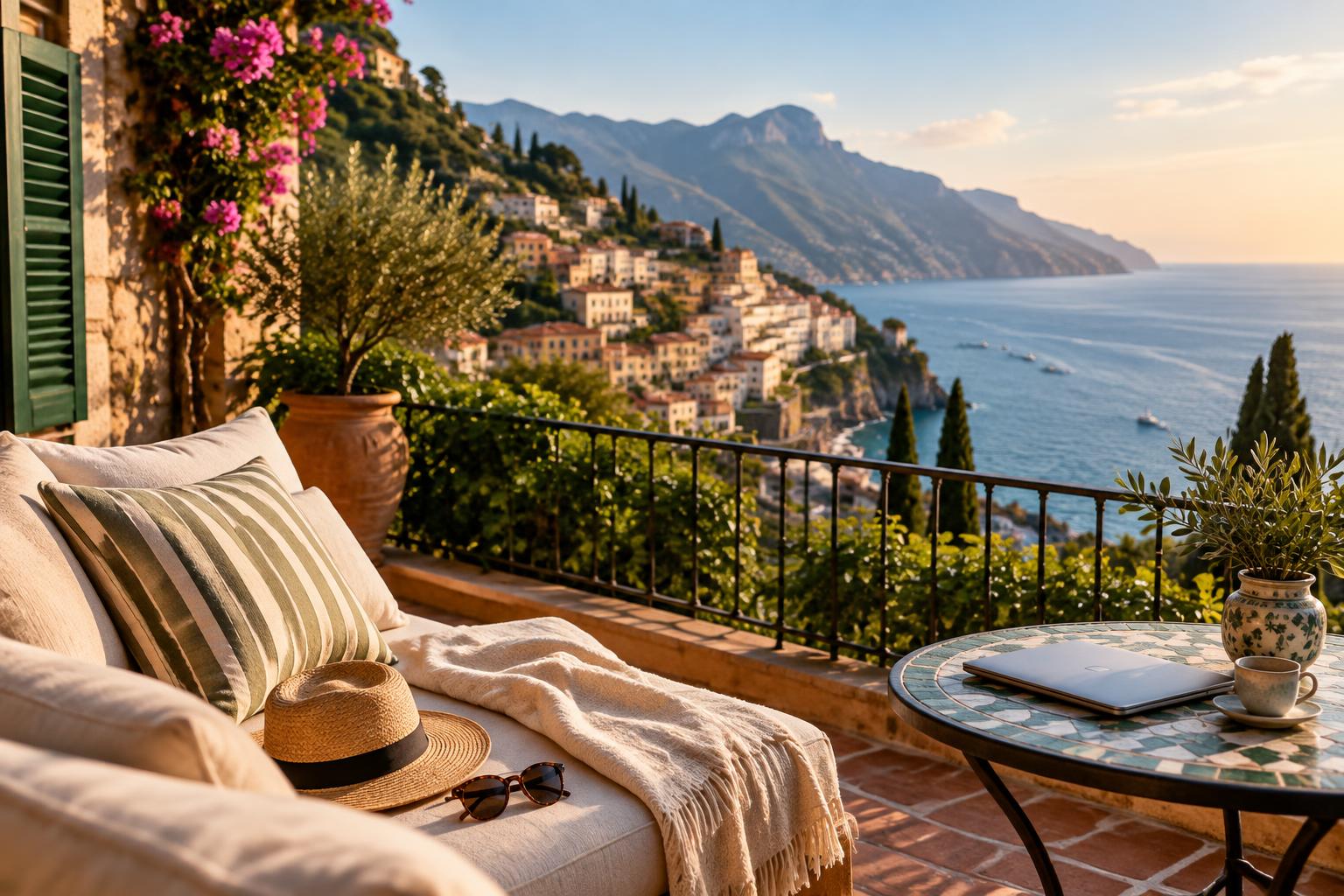
Getting away from it all does not have to mean choosing somewhere difficult to reach, giving up good food or spending a week in complete isolation. Italy offers another version of the escape: places where beautiful surroundings, comfortable stays and a slower daily rhythm make it easier to switch off without sacrificing the pleasures of travel. The right setting might be a stone city in Basilicata, a quiet Tuscan valley, an Alpine spa town or a small island in the Bay of Naples. All of them create distance from everyday routines in different ways. What connects them is the possibility of doing less, while still eating well, sleeping well and having something interesting to discover whenever the mood returns.
Val d’Orcia
Contents
In southern Tuscany, Val d’Orcia makes a convincing case for leaving part of the holiday unplanned.
Its appeal is spread across a landscape rather than concentrated in a single town. Cypress-lined roads cross rolling countryside between places such as Pienza, Montalcino and San Quirico d’Orcia, with vineyards, olive groves and woodland filling the spaces between them. The valley is recognised by UNESCO for a landscape shaped over centuries by the relationship between people and nature.
The best days here need very little structure. Drive to a hill town in the morning, stop for lunch and spend the afternoon somewhere entirely different—or return early and read beside a pool.
There is also a long relationship between the area and thermal water. Bagno Vignoni is particularly unusual, with its historic thermal pool occupying the centre of the village, while nearby hot-spring areas extend the wellness theme into the surrounding countryside.
Comfort in Val d’Orcia comes with space. That is often exactly what is missing from a conventional city break.
Lake Orta
Northern Italy’s lakes are obvious choices for elegant escapes, but not every stay needs the social energy of Lake Como or the geographical scale of Lake Garda.
Lake Orta, west of Lake Maggiore in Piedmont, offers a more intimate alternative. Orta San Giulio faces the small island of San Giulio, and much of the experience revolves around a compact historic centre, waterfront views and time spent close to the lake.
It is a destination particularly suited to mornings without alarms. Breakfast can become a long affair, followed by a boat trip or a walk through town. There is enough cultural interest to prevent boredom, but not so much that a visitor feels guilty for ignoring it for an afternoon.
That balance matters. A restorative holiday needs possibilities, not obligations. Lake Orta provides both scenery and refinement while remaining manageable enough for the days to feel genuinely slow.
Merano
For travellers who find mountains more restorative than beaches, Merano offers a very different Italian escape.
The South Tyrolean town sits in a landscape where Alpine scenery meets a surprisingly mild valley environment. Its identity has long been connected with spa culture, gardens and outdoor life, making wellness part of the destination rather than an activity added to it.
Days can alternate naturally between walking and recovery. The town’s promenades provide gentle routes when a demanding mountain hike sounds like the opposite of relaxation, while the surrounding area offers more ambitious trails for anyone wanting them.
Merano also has the advantage of feeling polished without requiring formality. Good restaurants, attractive architecture and spa facilities coexist with mountains that are visible from the town itself. It suits travellers who want to return from a break refreshed but still appreciate having choices beyond the hotel.
Matera
Matera may be a city, but the Sassi can produce a surprising feeling of separation from modern urban life. Their stairways, cave dwellings and stone façades create a landscape where the usual visual language of a contemporary city almost disappears.
This makes Matera particularly suitable for a short break built around a deliberately light schedule. One morning might be devoted to the rupestrian churches; another can begin with coffee near Piazza Duomo before descending through the Sassi without a fixed route. The Murgia landscape across the ravine adds open space to a destination usually associated with architecture.
Wellness also feels unusually connected to the setting here. Travellers can relax at the Palazzo Gattini Spa, where the spa occupies old cisterns and spaces carved into the stone and includes experiences such as a hammam and massages.
Matera therefore works for travellers who want quiet without complete inactivity. History remains immediately outside the door whenever it is time to explore again.
Procida
An island automatically creates a degree of separation, but Procida does it without requiring a long journey into remote territory.
The island lies in the Bay of Naples, yet its character differs noticeably from larger and more internationally famous neighbours. Its scale encourages simple routines: walking, swimming, eating and watching boats move in and out of the harbour.
Marina Corricella provides the scene most visitors remember, with houses rising in soft colours behind the waterfront. But Procida works best when it is not reduced to one photogenic harbour. Exploring slowly reveals small beaches, residential streets and viewpoints where the mainland can feel much farther away than it actually is.
The island is a particularly good choice for a short digital reset. There are things to see, but very little reason to race between them. An afternoon beside the water does not feel like time that should have been spent elsewhere.
What should a comfortable escape actually include?
Disconnecting is easier when the practical side of the trip requires little effort. A beautiful destination loses some of its restorative effect if every meal needs extensive planning or each day involves long transfers.
The most successful breaks usually have a few simple ingredients: somewhere pleasant enough to spend several hours without leaving, good food nearby, easy access to nature or interesting streets, and at least one form of physical relaxation.
Spa treatments can provide that pause, but so can thermal water, a garden, a terrace or an afternoon beside a lake. Comfort is less about filling a stay with services than about removing unnecessary decisions.
The location should do part of the work.
How long do you need to properly switch off?
A long weekend can be enough, especially in Matera, Lake Orta or Merano. Three nights create at least one complete day without arrival or departure interrupting the rhythm.
Four or five nights make more sense in Val d’Orcia, where the pleasure comes partly from exploring the countryside gradually. Procida can work either as a short island break or as the quiet conclusion to a longer journey through Campania.
Whatever the destination, avoid scheduling the first available hour. Arriving, unpacking and doing nothing for a while is not wasted travel time. It establishes a different pace from the one left at home.
The best escapes make doing less feel natural
Italy is particularly good at making relaxation feel like part of travelling rather than an absence of activity. A long lunch is also an introduction to regional food. A walk through Matera reveals centuries of architecture. An afternoon drive across Val d’Orcia becomes an encounter with one of Tuscany’s defining landscapes.
That is why disconnecting here does not require retreating entirely from the world.
Matera provides history and seclusion within the same stone streets. Val d’Orcia replaces schedules with countryside. Lake Orta reduces the Italian lake experience to a quieter scale, Merano combines mountains with wellness, and Procida introduces the uncomplicated rhythm of island life.
The real luxury is having interesting things nearby and feeling no urgency to reach them. Comfort makes staying in appealing; Italy makes eventually stepping outside worthwhile.