


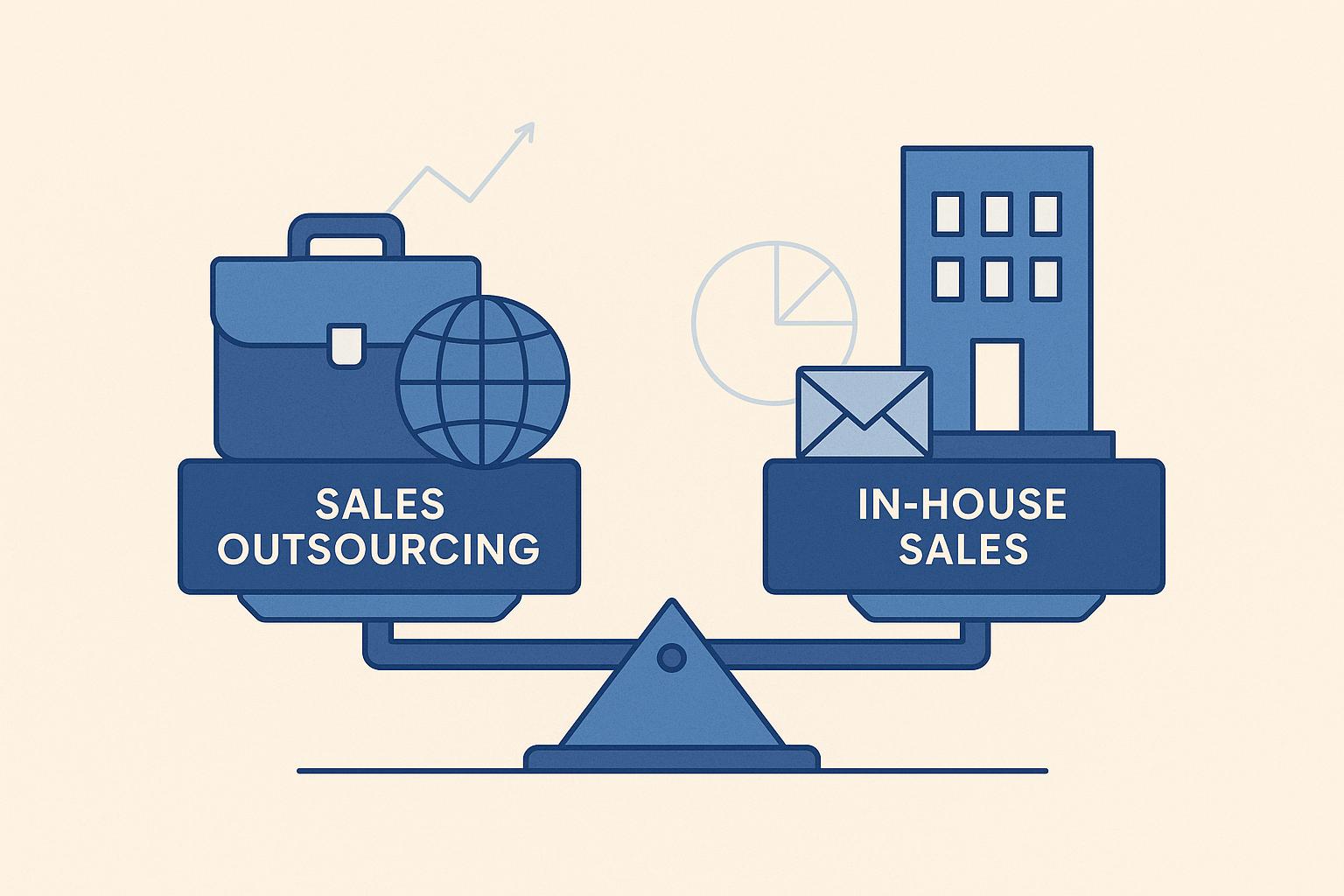
There is no universal answer to whether a business should build its own sales team or use an external provider. In-house staff provides management with control, while outsourced staff can provide experience in dealing with sales without having to hire many people. The choice usually comes down to the company’s goals, sales needs, and the resources it has at the moment.
What Is Sales Outsourcing?
Contents
Sales outsourcing means hiring an outside company to handle part of the sales work. This can include finding new leads, checking whether they are a good fit, booking sales appointments, or speaking with potential customers at the early stage. A business can outsource one part of the process or leave most of the sales work to the external team.
In-House Sales vs. Outsourcing: Key Differences
The in-house representative gets enough time to get to know the product, corporate culture, and customer base.
However, one must consider the cost that comes along with the choice. These include recruitment costs, salaries, training, software, and management. It will be months before the hired person becomes fully efficient.
How does an outsourced sales team function? The main advantage of such a team is that it enables one to increase capacity without increasing headcount. The drawback of the option is that the service provider will need some time to learn about the offer, target audience, and expectations.
When Is an In-House Sales Team the Better Choice?
The internal sales team is preferable in case:
- The product is complicated, and in-depth knowledge is necessary.
- There are expectations for account management.
- The company has sufficient demand.
- Managers want direct oversight of daily sales operations.
- Sales knowledge needs to stay within the business.
For a company with a steady pipeline and predictable sales cycle, developing internal expertise can make financial sense over the long term.
When Should a Business Consider Sales Outsourcing?
Outsourcing becomes more interesting when hiring a full team would be premature or too expensive. A fast-growing business might have a great product but need more staff for prospecting. Another company might consider evaluating the potential of entering a new market prior to hiring locally.
It might be an effective strategy if:
- The company is entering a new market.
- Current employees cannot handle prospecting activities.
- Management would like to gain access to outsourced B2B sales experience.
- Hiring a good sales team would be too time-consuming.
- The firm would need to reduce sales costs when exploring the growth potential.
Sales outsourcing for small businesses will give some additional capacity without immediate creation of multiple permanent positions.
The Benefits and Challenges of Outsourced Sales
Flexibility is probably the best advantage of this approach. The outside sales team would handle prospecting or the initial stage of selling while the inside sales team takes care of closing deals and handling current clients. It can also help implement already proven systems and sales resources that the small business lacks.
However, outsourcing is not a way to improve sales instantly. If the provider does not understand the product or receives poor information from the client, results can suffer.
How to Choose the Right Sales Model for Your Business
Analyse the sales process: consider deal size, sales cycle, lead volume, required expertise, and how much management time is available. Sales consulting can help a business compare these factors before making a commitment.
A hybrid model may also make sense. An internal team can manage important accounts and final negotiations, while an external partner handles prospecting and appointment setting.